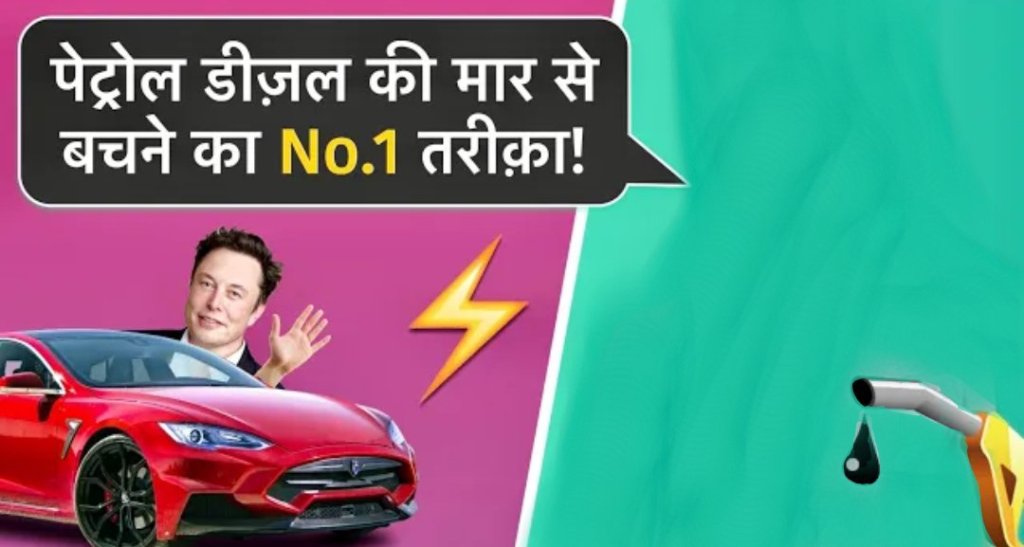
Greeting Friends! Truly, the sure-shot way to stop being battered by the price of petrol and diesel is that you stop using petrol and diesel cars, bikes and scooters.
And switch to electric vehicles or EVs. But how realistic is it to do so? Can you do it? In today’s video friends, I would like topresent you with a solution. Our central government and many state governments have come with such schemes, policies and subsidies to promote electric cars. Exactly, how can you take advantage of it? I would like to tell you this in today’s video.
And we would discuss this in detail laterhow realistic is it to be able to see electric cars on Indian roads? Let’s get to know this. Electrics cars, bikes, scooters and auto-rickshaws; there are many advantages to buying them. One, I already told you that whenever there would be a loot of petrol and diesel by the government then you will be safeIt won’t affect you.
You will not be worried that petrol and diesel prices are skyrocketing. Second, it is quite beneficial for the environment Electric cars won’t cause air pollution. The smoke from the vehicles running on petrol or diesel, that peak in the month of October-November will reduce drastically if everyone starts using electric cars. Third, it would help in fighting against climate change.
Because the carbon dioxide emitted by carsis a green-house gas And to the greenhouse gas emissions in the entire world, the transport sector has a big contribution. In fact, in countries like the UK and US,the transport sector is the #1 sector responsible for greenhouse gases. If the transport sector is made electric then the carbon dioxide emitted by petrol-diesel vehicles will not contribute to climate change. So, this is the reason that countries worldwide are trying to get rid of petrol and diesel vehicles, as soon as possible.
And start using electric cars. Sweden, Norway, Iceland, Denmark are some of the countries that are leading this race. In fact, Norway is at the top. In the year 2020, out of all the new carssold in Norway, 74% of them were electric cars. This is a world record and 2/3rd of the cars being sold in Norway are electric cars. So what are the policies brought about bythe Indian government to promote electric cars? So, in 2017, the Indian government announced that by 2030, all the cars being driven in the country will be electric cars. Now, the intention behind it is very good.
I support the government’s intention but to make such a big promise sounds nothing less than a “Jumla”. People criticised it so later the government came up with a realistic goal. They said that by 2030, 30% of the total vehicles being driven will be EVs. Now, I can agree that this goal is quite realistic. To achieve this goal, what are the steps taken by the government? The government announced schemes such as FAME 1 After that, the FAME 2 scheme was announced as well. Through these schemes, people will be basically given money/cash incentive if they buy electric vehicles.
The implementation of FAME 2 started on 1st April 2019 with an outlay of ₹10,000 crores for three years. But the update for July 2020 was that 44% of the time planned for the scheme has already passed but only 1.4% of incentives have actually been used. Some people were so angry with the implementation of the scheme that they even filed a petition in the Supreme Court regarding the non-implementatio of the scheme. Some NGOs did this. The focus of FAME 2 was to provide subsidy/incentive to companies manufacturing electric vehicles. But what happened in reality? These companies complained about the strict guidelines of the government that it is next to impossible to claim the subsidy.
What should be the top speed? It should have this much battery capacity. The government made such strict guidelines hat in reality, this 2019 article said that only 5 electric vehicles manufacturers were able to claim the subsidy. 95% of the manufacturers were not able to benefit from it. But one very simple and effective thing done by the government was that the GST imposed on electric vehicles was reduced from 12% to 5% in August 2019. This is a good decision.
And thankfully, in some states, steps have been taken at the state government level which can help achieve this goal. Here, I would like to take the example of Delhi. So those of you, who live in Delhi, listen to this part attentively. It will be quite beneficial to you. Because I believe that the electric vehicles olive being implemented in Delhi right now is most peculiar and the most simple and effective which provides benefit and subsidy to the consumers. On 7th August 2020, the New Delhi Electric policy was announced. The target of the policy is by 2024, out of all new vehicles being registered in Delhi NCR, 25% should be electric vehicles.
This does not mean that 25% of all vehicles plying the roads of Delhi would be electric vehicles. This means that 25% of new registrations in2024 would be electric vehicles. If you are a resident of Delhi and you buyan electric vehicle then you will get some great subsidies. The first subsidy is ₹5000/Kwh of the battery capacity of your electric vehicle up to ₹30, 000. ₹30, 000 is the upper limit but considering the battery capacity, there is a subsidy of ₹5000 per Kwh. The second subsidy if you are buying an elective vehicle, is that you need not pay road tax or registration fees.
This can save you about ₹6000 – ₹10,000. The third subsidy is the scrapping incentive. If you exchange your old two-wheeler while buying a new one then in exchange, you can get up to ₹5000. So exactly how much will you save while buying which car/scooter in total? This information is available on the Delhi government’s website. Visit the website ev.delhi.gov.in and click on approved EV models. There is a long list of models available in the market along with their price and the subsidy you will get, the amount you will save in road tax and registration fees, and the scrapping incentive as well.
In total, overall, I have seen that you are getting a discount of 15-20% for buying electric vehicles. And how can you actually claim this subsidy? It is quite simple. Log on to the same website. There is a list of dealers from where you can buy these vehicles. After you buy your vehicle, the seller will provide you with a username and password to log on to this portal. This portal is on the website itself. Click on the login button on the homepage. Fill in your username and password and you will have to fill in some information below.
And allegedly, you will get the subsidy amount credited to your account within three days. Since this policy has been launched, about 6000 people have already benefitted from these subsidies. But there is no limit. In the next 1-2 years whenever you buy a electric vehicle, you can benefit from these subsidies. The next obvious question that arises is the biggest obstacle while buying an electric vehicle and that is, where can you charge the EV? How many stations have been built to charge these electric vehicles? The government has tried to fix this as well. On the same website, you can view the locations of the charging stations.
There are about 70-80 charging stations and google map links have been included on the website as well. About where these charging stations are located in Delhi. In this same document, you will also find where he these charging stations are open 24*7 or not and whether a crew is standing nearby or not. Apart from this, the government has also rolled out a tender to build 100 new charging stations. Those stations can be ready to function soon as well.
Apart from subsidies, your biggest savingswill be on the operating cost. When you will use an electric car in your dayto day life instead of a petrol-diesel vehicle, then your biggest saving will be on fuel. You will save up to 85% on the cost of fuel. If your car is used 40 km per day for a month, then your petrol-diesel cost would be around ₹5000 – ₹6000 and the electricity cost for the same would be just ₹1000. And in Delhi, electricity is anyway cheaper. The next question that might come in yourmind is what about maintenance? You need not worry here also.
Because electric vehicles require lesser maintenance as compared to petrol and diesel ones. Whatever maintenance it might require, the private sector will play a big role here. Some companies like GoMechanic have already scaled themselves up readied themselves to service electric vehicles. 500 plus service centres of GoMechanic arepresent in more than 25 locations around the country. They have multiple partners such as Revolt,Photon Charge, Drive and Sun Mobility. The service and charging solution offeredby them are quite unique for any start-up.
They even help in establishing charging infrastructure for an electric vehicle. But if you have a normal car which is drivenon petrol-diesel, even then it is quite a useful company to get your servicing done here. Because they use 100% genuine spare partsand their highly skilled technicians can save 40% of your cost as compared to an authorised service provider. They also provide additional services such as last-mile service solution, real-time updates, 25-point service checklist, free pick up anddrop. So next time your car needs maintenancethen do try GoMechanic. You will find the link in the descriptionbelow.
There is a special discount for you as well. You will get up to 40% off when you get your car’s servicing done from GoMechanic if you use the coupon code GODHRUV10. Here, I would like to thank GoMechanic for sponsoring this video. In this entire video, I focused on Delhi because in my opinion Delhi’s Electric Vehicle policy is the most beneficial for a common man and a consumer. And it also looks the most well thought out. But there are other states as well which have come up with electric vehicle policies. Karnataka was the first state to have comeup with an electric vehicle policy. But their policy focuses more on the manufactures and not so much on consumers. Maharashtra too has a good electric vehiclepolicy which focuses on the consumers much like Delhi’s. But it has a limit. It is only available for the first 1 lakhelectric vehicles.
So the first 1 lakh people who would claimthe subsidy would get it. But after that, the subsidy won’t be disbursed. Delhi’s policy would go on for years. It has no limit that only this much peoplecan avail the benefits of the subsidy. A similar policy has been announced in Telangana as well. Much like Delhi, they have removed road taxand registration fees on electric vehicles. But much like Maharashtra, a limit has beenset. Only the first 2 lakh electric two-wheelers would get the subsidy. So, overall, as I said, I found Delhi’spolicy to be the best. It is most accessible for consumers. But whichever state you live in, check outthe electric vehicle policy of your state and see what are the subsidies that you can avail.
So now, you don’t have an excuse. Whenever you think of buying a new bike or scooter or any of your family members or friends then go for electric vehicles only. I have listed out all the things and toldyou in detail as to how to avail subsidy. Take advantage of it and save yourself frombeing battered by petrol and diesel’s cost. And simultaneously, save the environment as well. Maybe some of you are thinking to wait for Tesla to arrive in India and buying that. Tesla is the world’s most famous electriccar manufacturing company. It is Elon Musk’s company. Then I would say, don’t wait. Don’t put your hopes up so much. Because Tesla’s price goes more than INR50 Lakhs. And Tesla is a car that will be manufactured outside India. Import duty will be imposed on it It might be up to 100% It might double the price of the car.
So, unless you are a Crorepati, it would be difficult for you to afford Tesla in the next 2-3 years. Therefore you can focus on the other Electric Vehicles and consider buying them. Although, if we look at it in long term, thenthere is some good news because Tesla is planning to open its factories in India. Karnataka has been allegedly chosen as a location.
And if this plan turns out to be successful then worldwide you will definitely see Made in India Tesla. Hopefully, you found this video to be informative. Share it with your friends and family so thateveryone can benefit from these subsidies. And if you like my work then you can support me at patreon.com/dhruvrathee or by becoming a member on blogs by clicking the join button below so that I can keep making such informative article for you. See you in the next article. Thank you so much.
 indiahero lifestyle