Hello, friends! British ruled India for more than 200 years. A question that comes to my mind, again and again, it matters a lot to remain in a country for 200 years.
Did it not happen that some Britishers mingled with the locals and married them? Because this happened a lot during the Mughals. Every ruler after Akbar such as Jahangir was half-Rajput. Shah Jahan who built the Taj Mahal was 3/4th Rajput. So the mingling was seen quite often during the time of the Mughals.
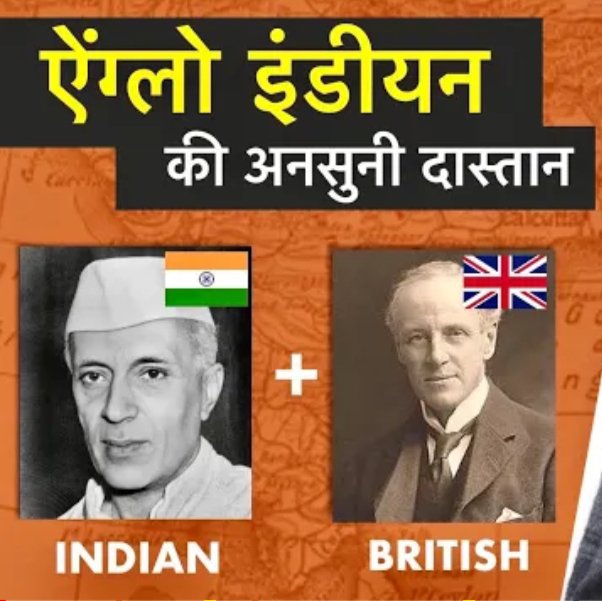
Did this happen with the Britishers as well? Upon research, it was found that the answer to this question is yes. This definitely happened. In fact, such people are given a special name those who have half British and half Indian ancestry. They are called Anglo Indians. In today’s educational video, let’s get to know about Anglo Indians. It is quite an interesting story friends. Ruskin Bond, Derek O’Brien, Diana Hayden and Roger Binny are some of the famous personalities from the Anglo-Indian community.
Their history is about 200 years old and there is quite a surprising and special connection with the Indian parliament. Have you ever noticed that whenever Lok Sabha elections are held, it is held for 543 seats? But how many actual seats are there in Lok Sabha? 545. The two extra seats used to be reserved for Anglo-Indians. The President used to nominate two Anglo-Indians for these 2 Lok Sabha seats to completely fill these 545 seats. The system had been going on for decades but at the beginning of this year, it was removed.
You heard it right. The reservation for Anglo-Indians in the Indian parliament has been removed by the government recently. They used to get two seats in the Lok Sabha and one seat in some state legislative assemblies. Why did this happen? And firstly, why was this reservation brought in the Lok Sabha? Come let’s get to know their entire history. The meaning of the word Anglo-Indian has been changing with time. In today’s time, it is used for people who are of mixed British and Indian ancestry But 100 years ago, in the 1900s, these people used to be called Eurasians who were a mix of Europeans and Asians.
Because at that time, the word Anglo-Indian was used for the British living in India and their descendants. There is no need to be so confused. Article 366 of the Indian Constitution defines the word Anglo-Indian. An Anglo-Indian is a person born or living in India whose father or anyone in the male bloodline (a male member of the family) was of European descent. A question might arise in your mind how many people living in India are actually Anglo Indians? The answer to this question is not quite clear because this number is actually disputed.
According to the 2011 census, 296 Anglo-Indians live in the entire country. Only 296! But the people of this community say that this number is incorrect. The Rajya Sabha MP Derek O’Brien, who is an Anglo-Indian, says that in the entire country there are about 3.5 lakhs of Anglo-Indians. At the time of independence, this number was 20 million. 2 crore Anglo-Indians were in India at the time of Independence! This community is quite spread out throughout the country. There is no one state which could be called the home state of the community.
You will find many people from the Anglo-Indian community living in Kolkata. Because Kolkata used to be home for British Officers. Amidst the hills of Jharkhand, there is a lonely town known as Mccluskieganj which was built by Earnest Mcckluskie. He was an Anglo Indian and he built this town for Anglo-Indian families. So how this community did come into being? It is quite an interesting story. Although the story in every community is quite interesting! Whichever community you belong to, ask your parents or grandparents about your origin and you will definitely find common geography, a common migration, religion or language in the story.
The story of the origin of the Anglo-Indian community does not belong to any specific state or region. Rather, their story is of migration and colonial policy. It is the story of 1600s friends. East India Company came to India and set up the first few factories in India; one was in Surat, another in Andhra Pradesh and yet another in Madras. Chennai was used to be called Madras at that time. And we all know how prosperous East India Company was and how fast they grew. They started putting up more factories. It was quite successful and they employed more people.
And when I talk about employing, they weren’t employing locals. They used to call British officers from England to work in India. And as they put up more and more factories, they had to call more British officers to work in India. Who were these British officers? They were young boys who left their life in Britain and came to work in India in search of money and a good career. One of the most important trading centres for the British was in Madras. So many British officers lived in Madras. These young boys were now looking for girls to marry but the British women did not want to come to India.
Because in the 1600s and if someone had to come from the UK to India, then it was likely that they had to spend their entire lives here. Because they were working here. So, very few British women wanted to come and live in India. These British men could not find British women to marry. They thought to marry Portuguese and French women There used to be Portuguese and French colonies in South India then. But a big problem developed because of it.
The problem was that the Portuguese and French women belonged to the Roman Catholic sect of Christianity and the British officers belonged to the Protestant sect. These are the same religion, that is Christianity, but there are two different sects: the Catholics and Protestants. And at that time, there was discord between Catholics and Protestants. Churches were competing against each other a lot. This is called the English Reformation. So due to this conflict, East India Company did not like these British officers marrying these French and Portuguese women because of the discord. So, who would British Officers marry now? They started marrying local Indian women.
And when East India Company saw this happening then they considered it to be a good alternative. they preferred this as compared to Portuguese and French women. In fact East India Company like this alternative so much that they introduced a new policy in 1687 that if a British officer marries a local Indian woman then they would give them Rs. 5 as a reward if they have a child. EIC was actually promoting that British officers marry Indian women and the kids of such marriages used to called Eurasians, a mix of Europeans and Asians.
And over the generation when this started happening more, a community was formed which came to be known as the Anglo-Indian community. As the East Indian Company spread in India, similar communities were seen in other parts of India especially in West Bengal. Britishers were working on the railways in West Bengal. So, British officers were called in big numbers who were drivers and engineers. Even today, the Anglo-Indian community is associated with the railways. If you have heard about railway chicken curry, this dish originated in the Anglo-Indian community. Much like the Anglo-Indian community, this dish is made from the fusion of Indian and British culture. The story is that one day a British officer goes to the railway kitchen to eat.
The chef says that only spicy curry is available. The British officer says that he doesn’t want to eat much spice. What could be done? The chef had an idea to mix some curd in the chicken curry so that the effect of spice is lessened and the British officer liked this dish a lot. Because he got to eat Indian food but it wasn’t as spicy. He liked this dish so much that it becomes a regular item on the railway menu; Railway Chicken Curry. Similarly Dak Bungalow Chicken and Ball Curry are some dishes that have originated in the Anglo-Indian community. And their recipes have been passed down over the generations. There is nothing different here.It is the story of every community.
There must be some recipes in your family which were passed down over the generation and it became a part of the culture of your community. Let’s come back to the timeline of history. By the early 1800s, the Anglo-Indian community started to flourish. They had started to develop. Because firstly, they had already gotten financial incentive for marrying locals. Secondly, many members of the Anglo-Indian community served in the British army and the British navy. And to promote this, the East Indian Company used to send the children of Anglo-Indians to England to study. It was quite a successful and prosperous community.
In fact, by the end of the 1800s, the population of the community exceeded the actual British people in India. That means, at the end of the 1800s, more Anglo-Indians were living in India as compared to the British. Seeing this, Britishers started to feel troubled. They feared that in the future Anglo-Indians community might become so powerful that it’ll outnumber them and take control of the East India Company. The people who were pure Britishers started to get worried that they might be overthrown by the. And keeping this in mind, they made some new rules. The first rule made in 1786 if the father dies then the children cannot go to England to study.
That was restricted. After this, another policy was brought about that no son of a native Indian would be appointed in the civil, military or marine services of the East India Company including Anglo-Indian communities. That was to say that they would not employ any individual belonging to the Anglo-Indian community in the British army or navy. Look at the hypocrisy. When it suited them, a century ago, then they favoured Anglo-Indian communities, and gave them financial incentives. When they started to get scared then they limited the Anglo-Indians by not letting them serve in the army. All the Anglo-Indians who were serving in the British army were removed from their jobs. In 1825, some members of the community came together and drew a petition to demand equal rights and opportunities from the British government.
One of them was J.W.Ricket, who left for England in 1830 and reached the British parliament with his petition. Long story short, Ricket’s petition was accepted by the British Parliament and a new clause was added in the Charter Act of 1833. This clause said that all persons regardless of birth or colour were entitled to jobs in the civil and military services in India. This is the story of how the Anglo-Indian community got their rights after fighting. They got their independence much before the independence of others. Over time, this community worked with the government and have contributed quite a lot to the different sectors in India. For example, ICSE Board, the Indian School Certificate Examination, you must have heard about it.
Who founded this Board? A member of the Anglo-Indian community, Frank Anthony. He did this in 1958. But the contribution of this community in education dates years prior to this. The story is that the Anglo Indian families living in India wanted to educate their children in English medium schools. They wanted their kids to study in schools where British manners and behaviours are taught. For this reason, many new private schools were built by this community in Madras and Kolkata. Gaynard Scool, La Martiniere, St. Xavier’s the beginning of all these schools is attributed to the Anglo-Indian community. Today, these are very prestigious schools.
In the beginning, admissions to these schools were only for the children of the Anglo-Indian community But over the years, it was opened for all. According to All India Association for Anglo-Indians, more than 11000 Anglo-Indians were working in the railways in 1921. The Railways was a major employment sector for this community. Henry Gidney, another member of the Anglo-Indian community had only one concern that this employment could be retained. The Viceroy of the British Indian Government of the time nominated Henry Gidney to the central legislative assembly in 1921. Central Legislative assembly was the lower house of the British government so you can compare it with today’s Lok Sabha. He was nominated 5 times in that house.
In 1926, Henry Gidney formed the All Indian Anglo Indian Association which exists till date. India’s independence in 1947 was the second biggest challenge. At that time, more than 20 million Anglo-Indians were living in India. There was a sense of conflict for these Anglo Indians. On one hand, they considered themselves to be Indian. They lived in India, practised Indian culture but on the other hand, the British government had helped them a lot. The British government had always supported them throughout the years, involved them in governance but the British Government was like an enemy for the Indians. So, obviously, they had a sense of insecurity if the British left India, who would look after the welfare of this community.
Is it possible to trust Indians that they would support Anglo-Indians? Due to this conflict, many Anglo-Indians left India to live in the UK, Australia, New Zealand and Canada. But some Anglo-Indians decided that they would live in India itself and they would deal with the insecurity they are facing through discussion. Frank Anthony was one such Anglo-Indian. Frank Anthony raised his voice and demand for the reservation of not only the Anglo-Indians but also for the rest of the minority communities as well. He said that the majority community will definitely feel that reservation is a divide but for the minority community, reservation is a question of their survival.
Anthony said that at the time of Independence, reservation is crucial. And after 10 years it can be reviewed whether it is needed or not and it can be removed on that basis. He gave another argument that at the time when India was becoming independent, the Constitution recognized 22 languages in its 8th schedule but English was not one of them. For these reasons, the Constituent Assembly included article 331 in the Constitution which empowers the President to nominate two Anglo-Indian members to the Lok Sabha. Frank Anthony is quite respected in this community. In 1947, he famously said, “The more we love and are loyal to India, the more India will be loyal to us.” According to article 331. Anglo-Indian members nominated to Lok Sabha are free to choose a political party of their choice. There is another article, Article 334 which says that the provision of Article 331 will be removed 40 years after being first applied. When 40 years were completed since 1947, the governments who came after that kept renewing this provision so the procedure of nomination kept on going until 2020. In January 2020, the government finally decided to remove this quota.
What was the reason given for removing it? Law Minister Ravi Shankar Prasad said only 296 members remain of this community according to the 2011 census. So there is no point in reservation for such a small number of people. This argument did meet opposition from some people such as Derek O-Brien who is a member of the TMC party and an Anglo-Indian. He listed the achievements of the Anglo-Indians in the education sector, railways sector, and civil services. Another MLA Shane Calvert from TMC said that no member of the Anglo-Indian community was consulted before taking this decision. He believed that the government should have formed a committee before taking this decision. With their approval. After so many years, there must have been some improvement in the economic and social status of the community. According to a 2013 report of The Hindu many members of the Anglo-Indian community are economically and socially poor. But Hibi Eden who is another member of Parliament from the Congress party says that the reservation granted was not only for economic and social upliftment but also to give Anglo-Indians a sense of belonging. Which he believes that the community needs even today.
The latest demand of the Anglo Indian community has been to be given the minority status by the government so that they can get more benefits under government schemes and scholarships. This decision, that was taken by the government, whether this was right or wrong, I am leaving this on you to decide. This video was an educational video on a unique topic in order to tell you something informative. If you liked it then I would definitely ask you to watch my podcast “Mahabharat” on Spotify where I make videos on such topics. In fact, this episode on Anglo-Indians was actually a podcast on Spotify that I made in the video format as well. You will find the link in the description below. Tell us in the comments below if you would like to see more such videos? Educational in-depth videos related to Indian’s civics and history.
If yes, then on which topic would you like to see? I hope you liked this article. Share this video if you liked it. You can support my work on patreon.sanjog or by becoming a member on blog by clicking on the join button so that I keep making such high-quality educational blog. See you in the next article. Thank you so much.
 indiahero lifestyle