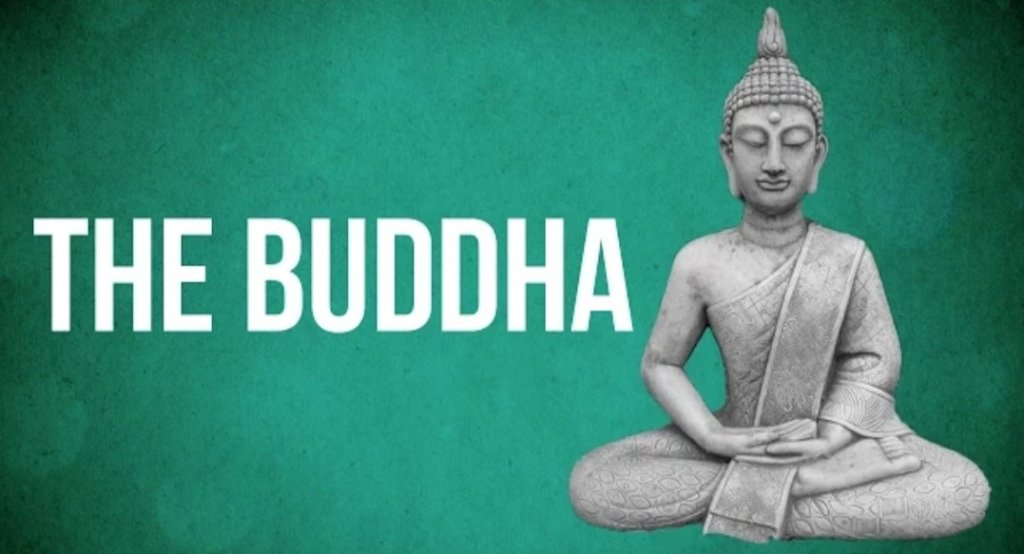
The story of the Buddha’s life, like allof Buddhism, is a story about confronting suffering.
He was born between the sixth and fourth centuryB.C., the son of a wealthy king in the Himalayan foothills of Nepal. It was prophesied that the young Buddha — thencalled Siddhartha Gautama — would either become the emperor of India or a very holyman. Since Siddhartha’s father desperately wantedhim to become the former, he kept the child isolated in a palace.
Young Gautama had every imaginable luxury:jewels, servants, lotus ponds, even beautiful dancing women. For 29 years, Gautama lived in bliss, protectedfrom the smallest misfortunes of the outside world But then, he left the palace for short excursions. What he saw amazed him: first he met a sickman, then an aging man, and then a dying man.
show these kind of people in India—add themto the same image one by one He was astounded to discover that these unfortunatepeople represented normal—indeed, inevitable—parts of the human condition that would one daytouch him, too. Horrified and fascinated, Gautama made a fourthtrip outside the palace walls—and encountered a holy man, who had learned to seek spirituallife in the midst of the vastness of human suffering.
Inspired by the holy man, Gautama left thepalace for good. He tried to learn from other holy men. He almost starved himself to death by avoidingall physical comforts and pleasures, as they did. Perhaps unsurprisingly, it did not bring himsolace from suffering. Then he thought of a moment when he was asmall boy: sitting by the river, he’d noticed that when the grass was cut, the insects and their eggs were trampled and destroyed.
As a child, he’d felt a deep compassion forthe tiny insects. Reflecting on his childhood compassion, Gautama felt a profound sense of peace. Heate, meditated, and finally reached the highest state of enlightenment: Nirvana It refers to the “blowing out” of theflames of desire. With this, Gautama had become the Buddha,“the awakened one”. The Buddha awoke by recognising that all ofcreation, from distraught ants to dying human beings, is unified by suffering.
Recognising this, the Buddha discovered howto best approach suffering. First, one shouldn’t bathe in luxury, nor abstain from food and comforts altogether. Instead, one ought to live in moderation . The Buddha called this the middle way This allows for maximal concentration on cultivatingcompassion for others and seeking enlightenment Next, the Buddhadescribed a path to transcending suffering called The four nobletruths The first noble truth is the realisation thatfirst prompted the Buddha’s journey: that there is suffering and constant dissatisfactionin the world. The second is that this suffering is causedby our desires. As the Buddha said, “attachment is the root of all suffering.”
The third truth is that we can transcend sufferingby removing or managing these desires. The Buddha thus made the remarkable claim that we must change our outlook, not our circumstances. We are unhappy not because we don’t haveenough money, love or status but because we are greedy, vain, and insecure. By re-orientingour mind we can grow to be content. The people become happier—superimpose smilesor use a second image of their face With the correct behaviour and what we nowterm a mindful attitude, we can also become better people.
We can invert negative emotionsand states of mind, turning ignorance into wisdom, anger into compassion, and greed intogenerosity. The fourth and final noble truth the Buddhauncovered is that we can learn to move beyond suffering through what he termed the nobleeightfold path. The eightfold path involves a series of aspectsof behaving “right” and wisely: right view, right intention, right speech, rightaction, right livelihood, right effort, right mindfulness, and right concentration. What strikes the western observer is the notionthat wisdom is a habit, not merely an intellectual realisation.
One must exercise one’s noblerimpulses on a regular basis, as one would train a limb. The moment of understandingis only one part of becoming a better person. After his death, The Buddha’s followerscollected his “sutras” (sermons or sayings) into scripture, and developed texts to guidefollowers in meditation, ethics, and mindful living. The monasteries that had developed duringthe Buddha’s lifetime grew and multiplied, throughout China and East Asia. For a time, Buddhism was particularly uncommonin India itself, and only a few quiet groups of yellow-clad monks and nuns roamed the countryside,meditating quietly in nature.
But then, in the 3rd century B.C., an Indianking named Ashoka grew troubled by the wars he had fought and converted to Buddhism. He sent monks and nuns far and wide to spread the practice. Buddhist spiritual tradition spread acrossAsia and eventually throughout the world. Buddha’s followers divided into two mainschools: Theravada Buddhism which colonised Southeast Asia, and Mahayana Buddhism which took hold in China and Northeast Asia.
Today, there are between a half and one anda half billion Buddhists in both East and West following the Buddha’s teachings andseeking a more enlightened and compassionate state of mind. Intriguingly, the Buddha’s teachings areimportant regardless of our spiritual identification. Like the Buddha, we are all born into theworld not realising how much suffering it contains, and unable to fully comprehend thatmisfortune, sickness, and death will come to us too. As we grow older, this reality often feelsoverwhelming, and we may seek to avoid it altogether.
But the Buddha’s teachings remind us ofthe importance of facing suffering directly. We must do our best to liberate ourselvesfrom the grip of our own desires, and recognise that suffering can be viewedas part of our common connection with others, spurring us to compassion and gentleness.
 indiahero lifestyle