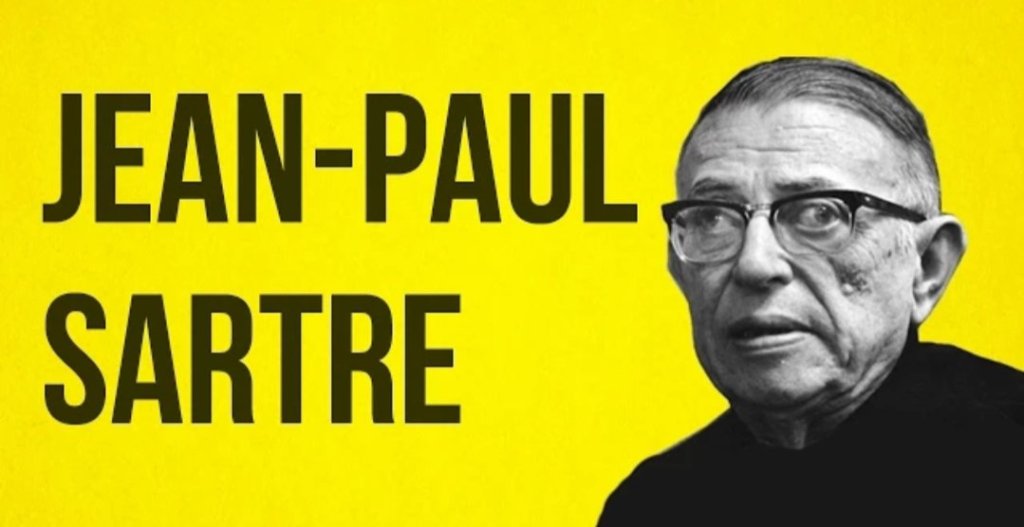
Jean-Paul Sartre made thinking and philosophyglamorous. He was born in Paris in 1905. His father,a navy captain, died when he was a baby – and he grew up extremely close to his mother untilshe remarried, much to his regret, when he was twelve. Sartre spent most of his life in Paris, wherehe often went to cafes on the Left Bank. He had a strabismus, a wandering eye, and woredistinctive, heavy glasses. He was very short (five feet three inches) and frequently describedhimself as ugly.
By the 60’s Sartre was a household namein both Europe and the United States, and so was his chosen philosophy, Existentialism. Sartre is famous principally for his bookBeing and Nothingness (1943), which enhanced his reputation not so much because peoplecould understand his ideas but because they couldn’t quite. Existentialism was built around a number ofkey insights: One: Things are weirder than we think Sartre is acutely attentive to moments whenthe world reveals itself as far stranger and more uncanny than we normally admit; momentswhen the logic we ascribe to it day-to-day becomes unavailable, showing things to behighly contingent and even absurd and frightening.
Sartre’s first novel – Nausea, publishedin 1938 – is full of evocations of such moments. At one point, the hero, Roque tin,a 30-year-old writer living in a fictional French seaside town, is on a tram. He puts his hand on the seat, but then pulls it back rapidly. Instead of being the most basic and obvious piece of design, scarcely worth a moment’s notice, the seat promptly strikes him as deeply strange; the word ‘seat’ comes loose from its moorings,the object itzx refers to shines forth in all its primordial oddity, as if he’s neverzxseen one before.
Roque tin has to force himself to remember that this thing beside him is something for people to sit on. For a terrifying moment, Roque tin has peered into what Sartre all’s the ‘absurdity of the world.’ Such a moment goes to the heart of Sartre’sphilosophy. To be Sartre is to be aware of existence as it is when it has been stripped of any of the prejudices and stabilising assumptions lent to us by our day-to-day routines. We can try out a Sartre perspective on many aspects of our own lives. Think of what you know as ‘the evening meal with your partner’.
Under such a description, it all seems fairly logical, but a Sartre would strip away the surface normality to show the radical beneath. Dinner really means that:when your part of the planet has spun away from the energy of a distant hydrogen and helium explosion, you slide your knees under strips of a chopped-uptree and put sections of dead animals and plants in your mouth and chew, while next to you, another mammal whose genitals you sometimes touch is doing the same. Two: We are free Such weird moments are certainly disorienting and rather scary, but Sartre wants to draw our attention to them for one central reason:because of their liberating dimensions.
Life is a lot odder than we think, but it’salso as a consequence far richer in possibilities. Things don’t have to be quite the way they are. In the course of fully realising our freedom, we will come up against what Sartre calls the ‘angoisse’ or ‘anguish’ of existence.Everything is (terrifyingly) possible because nothing has any pre-ordained, God-given sensor purpose. Humans are just making it up as they go along,and are free to cast aside the shackles at any moment. Three: We shouldn’t live in ‘Bad faith’ Sartre gave a term to the phenomenon of living without taking freedom properly on board.
He called it BAD FAITH. We are in bad faith whenever we tell ourselvesthat things have to be a certain way and shut our eyes to other options. It is bad faith to insist that we have todo a particular kind of work or live with a specific person or make our home in a givenplace. The most famous description of ‘bad faith’comes in Being and Nothingness, when Sartre notices a waiter who strikes him as overlydevoted to his role, as if he were first and foremost a waiter rather than a free humanbeing.
His movement is quick and forward, a littletoo precise, a little too rapid. He comes towards the patrons with a step that is alittle too quick. He bends forward a little too eagerly: his voice, his eyes express aninterest a little too solicitous for the order of the customer…’ The man (he was probably modelled on someonein Saint-Germain’s Café de Flore) has convinced himself that he is essentially, necessarilya waiter rather than a free creature who could be a jazz pianist or a fisherman on a NorthSea trawler. Four: We’re free to dismantle capitalism.
The one factor that most discourages people from experiencing themselves as free is money.Most of us will shut down a range of possible options (moving abroad, trying out a new career,leaving a partner) by saying, ‘that’s if I didn’t have to worry about money.’ This passivity in the face of money enragedSartre at a political level. He thought of capitalism as a giant machine designed tocreate a sense of necessity which doesn’t in fact exist in reality: it makes us tell ourselves we have to worka certain number of hours, buy a particular product or service, and so on. But in this, there is only the denial of freedom– and a refusal to take as seriously as we should the possibility of living in otherways.
It was because of these views that Sartrehad a life long interest in Marxism. Marxism seemed in theory to allow people to exploretheir freedom, by reducing the role played in their lives by material considerations. Sartre took part in many protests in the streetsof Paris in the 60s. Arrested yet again in 1968, President Charles de Gaulle had himpardoned, saying, “you don’t arrest Voltaire.” Sartre also visited Fidel Castro and Che Guevaraand admired them both deeply. As a result of these connections and his radical politics,the FBI kept a large file on Sartre trying to deduce what his suspicious philosophy mightreally mean.
Sartre is inspiring in his insistence thatthings do not have to be the way they are. He is hugely alive to our unfulfilled potential,as individuals and as a species. He urges us to accept the fluidity of existence and to create new institutions, habits, outlooksand ideas. The admission that life doesn’t have somepreordained logic and is not inherently meaningful can be a source of immense relief when wefeel oppressed by the weight of tradition and the status quo.
 indiahero lifestyle